
Looking back from my vantage point in 2026, some of the most memorable and hilariously chaotic moments I've experienced in Valorant didn't come from the high-stakes ranked climbs or the meticulous strategies of professional play. No, they came from a two-week period back in 2021, a glorious, unhinged interlude called the Replication mode. I remember it vividly—the total madness of five identical agents clashing on-screen, a concept so simple yet so brilliantly disruptive to the game's core tactical DNA. It arrived with the 2.09 patch, a temporary replacement for Escalation, and for those fourteen days, the game felt like a wonderfully different beast.
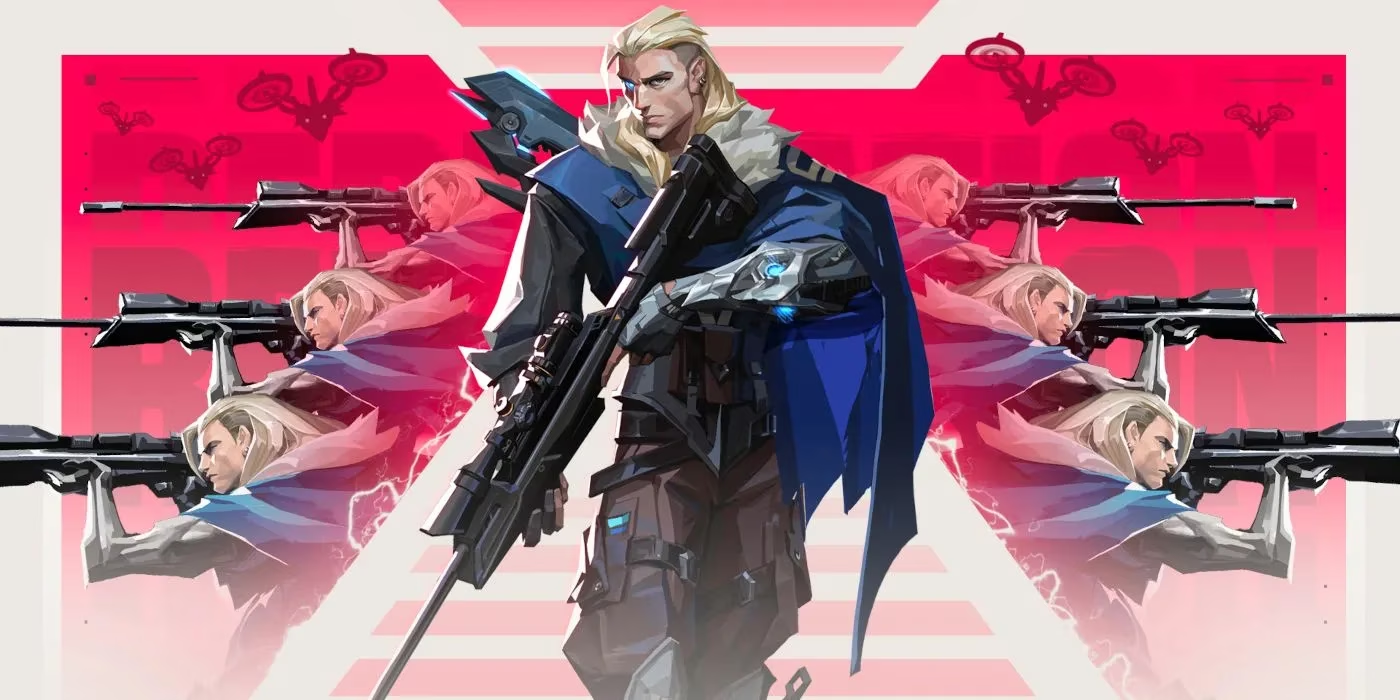
The premise was deceptively straightforward: a lobby vote would decide one agent, and then every single player on your team would spawn as that character. The rules were otherwise similar to the standard Unrated mode, but that one twist changed everything. I recall the frantic pre-match votes, the lobbying for your favorite agent, and the instant, giddy camaraderie (or dread) that set in once the choice was locked in. Would we be a squad of five teleporting duelists? A wall of sentinel traps? The potential for both epic synergy and catastrophic failure was immense.
Riot, to their credit, knew they had to implement some safeguards against the absolute pandemonium this would create. The most famous of these was the "Flashguard" system. 😵 Imagine this: you're navigating a narrow corridor on Bind, and suddenly, a blinding light fills your screen. You stumble back, vision clearing, only for another flash to hit you instantly from a different angle. In Replication, if you were flashbanged twice within four seconds, Flashguard would activate, granting you a precious five seconds of immunity. This was a necessity, especially when facing a team of five Phoenixes or five Breaches. Without it, matches would have been nothing but a perpetual white screen!
Beyond Flashguard, the mode had other quality-of-life tweaks that encouraged constant, aggressive play:
-
Full replenishment every round: Weapons, abilities, and shields were completely refreshed at the start of each round. No more economy management!
-
Ultimate acceleration: While ultimates didn't refresh, you earned one ultimate point per round, ensuring those game-changing abilities came online much faster.
As Lisa Ohanian, the game's production manager, pointed out at the time, the inspiration was clear: League of Legends' beloved One-For-All mode. Translating that MOBA chaos into a precise tactical shooter was a stroke of genius. The game's balance, meticulously crafted for diverse team compositions, was thrown out the window, and we players were left to revel in the beautiful chaos that ensued.
And chaos it was. Let me paint you a picture of some of the matches that are seared into my memory:
The Phoenix Inferno 🔥: Five Phoenixes on each team. The entire map became a literal sea of fire. Hot Hands littered the ground, Blaze walls cut the sites into bizarre sectors, and the final round always, always ended with ten Run It Back ultimates popping nearly simultaneously. It was less a tactical shooter and more a spectacular fire festival.
The Killjoy Fortress 🤖: Defending a site meant it would be physically impossible to walk onto it without triggering an alarmbot, being slowed by a nanoswarm, or getting shredded by a turret. With five Killjoys, we could lock down an entire map. Pushing through a chokepoint meant facing a wall of five turrets—a truly terrifying sight.
The Sova Intelligence Grid 🏹: Recon darts and shock darts filled the sky like a violent hailstorm. There was nowhere to hide. The constant drone of revealed enemies and the crackle of chain lightning shocks created a uniquely oppressive, information-dominated game.
The mode was a fantastic playground for discovering unintended agent synergies and pushing their mechanics to the absolute limit. It also, in a strange way, made me appreciate the standard game's balance even more. While Replication was pure, unadulterated fun, it highlighted why having a balanced team composition is so crucial for Valorant's core identity.
It's fascinating to think that Replication's release window was also a time when Riot was beginning to tackle some of the more serious issues in online gaming. Just before the mode dropped, they had announced plans to combat hate speech and disruptive behavior by implementing voice chat recording in Valorant, starting with beta tests in North America. It was a reminder that beneath these fun, temporary modes was a living ecosystem the developers were constantly working to improve and protect.
For two weeks in May 2021, Replication took over. It was a limited-time experiment that, in my opinion, was a resounding success. It proved that Valorant could step outside its serious, competitive shell and embrace pure, joyful chaos without compromising the tight feel of its gameplay. Every now and then, my friends and I still talk about those matches—the five-Viper ultimates that covered the entire map in toxic gas, the five-Jett dash storms onto a site. In the years since, Riot has introduced other fun modes, but Replication holds a special place as the first to so perfectly break its own rules for our amusement. I sincerely hope, even now in 2026, that they consider bringing it back for another round of beautiful, replicated chaos. 🎭