
Let me tell you, the first time I summoned a wave and watched a High Tide curve around a corner, I was hooked. It wasn't just about blocking sightlines anymore; it felt like I was painting with water, reshaping the battlefield itself. Harbor, the water-wielding Controller, has always been a bit of an oddball in the roster. He doesn't just drop smokes; he builds temporary aqueducts and rolling tsunamis. And in 2026, with the meta constantly shifting, mastering his unique flow has become my personal obsession. It's a different kind of control, you know? Less about static denial and more about dynamic, calculated chaos.
1. Unleashing the Tidal Wave on Attack
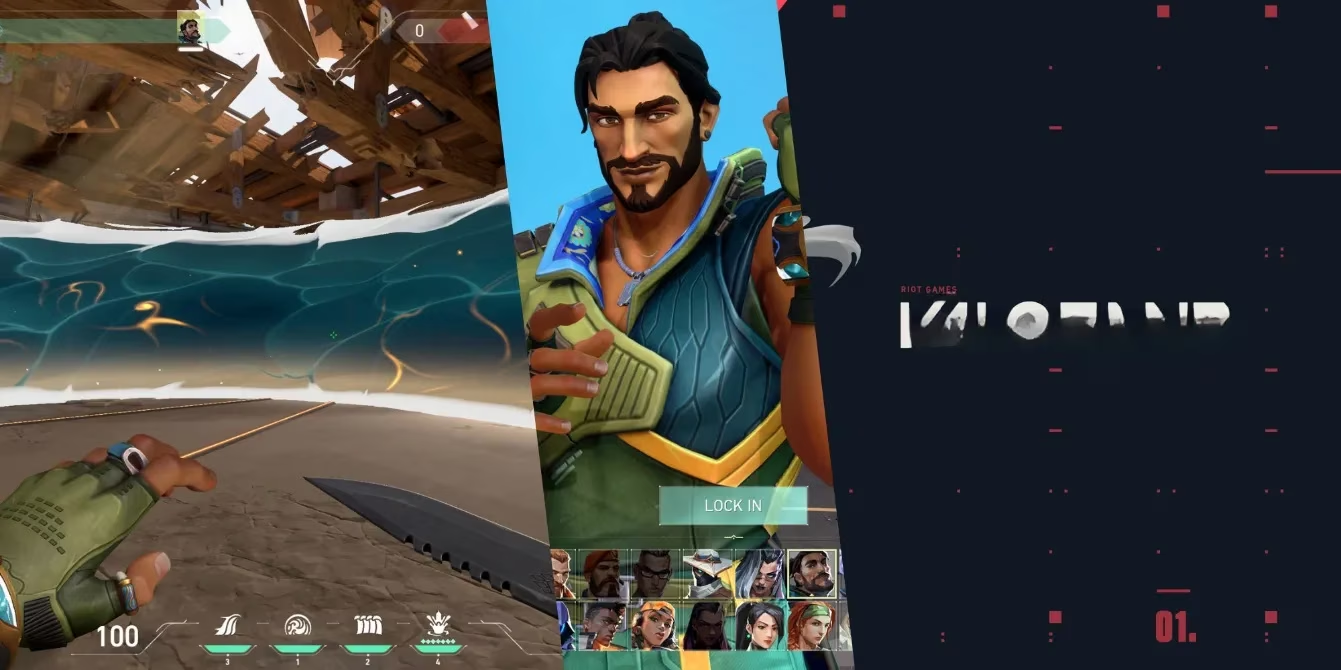
When my team signals the push, that's my cue. The best opener? Leading with a High Tide to drown out common defender angles. But here's the trick everyone forgets at first: you can curve it. Holding down the fire button lets you weave that wall like a serpent. I've spent hours in custom games just practicing these lineups, finding spots where a single, snaking High Tide can cut off two or even three crucial lanes. Covering A-Rafters and Tree room on Ascent from the safety of A-main? Oh, that's the good stuff. Following it up with a Cascade down our entry path is like creating a moving fortress for my duelists. It blocks those pesky long-range picks while we make that final, heart-pounding dash onto site. Just gotta watch for those sneaky lurkers hiding in tight corners as the wave rolls past. Talk about a baptism by fire... or water, I guess!
2. The Art of Patient Defense
On defense, I learned the hard way that playing Harbor like a frontline fragger is a one-way ticket to the spectator screen. He's got no "get out of jail free" card. My golden rule? Play safe and play patient. I used to panic and throw my Cascade at the first sound of footsteps, only to be left with nothing when the real execute hit. Now, I hold my utility like precious gems. High Tide is reusable, so it's okay to use it early to stall, but my single Cove and precious Cascade charges? Those are for the clutch moments. If I see the enemy committing, that's when I unleash the floodgates. Using abilities early often leaves you high and dry, wishing you had just waited a few more seconds. And let me tell you, nothing feels worse than being caught with an empty cooldown when the enemy rushes in.
3. Cove: The 350-Credit Lifesaver
Speaking of Cove, this ability is... expensive. Like, "think twice before buying it" expensive. Brimstone gets three cheap smokes; I get one orb that costs a small fortune. I had to learn to treat it not as a common tool, but as a round-winning investment. I save it for the absolute must-have situations: securing a risky Spike plant, blocking the final defuse, or creating a lifesaving pocket for a teammate in a 1vX. Wasting a Cove feels terrible—it hits your economy hard and can cost you the next few rounds. But using it to win a crucial round? That's the stuff legends are made of.
4. Finding Harbor's Sweet Spot: The Map Matters
Not all maps are created equal for a guy who controls water. Harbor absolutely shines on maps with tighter, more intimate Spike sites. Ascent and Bind are his playgrounds. A single, well-curved High Tide can wrap around an entire site, making defenders feel utterly claustrophobic. On the other hand, wide-open spaces like Breeze can be a real struggle. His walls feel like trying to hold back the ocean with a teaspoon—they just can't cover all the angles. It doesn't mean he's useless there, but you have to be much more selective and creative with your placements. Knowing which maps make your kit sing is half the battle.
5. Reckoning: The Ultimate Tide Turner
My ultimate, Reckoning, is my signature move for chaos. It's not a long-range snipe like some other ults; it's a close-range, area-denial monster. I use it to stop a plant dead in its tracks, to scatter defenders holding a tight angle, or to completely shut down a site during a retake. The area it covers is huge, comparable to something like Killjoy's Lockdown. The key is timing and positioning. Since I have to be relatively close to cast it, I can't just fire and forget from across the map. It's a commitment. And just like my other abilities, the casting sound is a dead giveaway that "Harbor is right here!" So you have to make that commitment count.
6. Cascade: More Than Just a Waterfall
At first, I thought Cascade was just a moving wall. Boy, was I wrong. It's a Swiss Army knife of disruption. Sure, it blocks vision, but it also slows enemies and physically pushes them back while it's traveling. This opens up so many creative plays. I can use it to hold a choke point temporarily, to flush out a corner, or to provide a few crucial seconds of cover for my team to reposition. The fact that it's active during its travel time is what sets it apart from other static smokes or walls. That brief window is a gift—use it wisely.
7. The Initiator Mindset
Here's the biggest mindset shift that transformed my Harbor play: stop thinking like a pure Controller, start thinking like an Initiator. Even though the game lists him as a Controller, his true power lies in initiating fights and disrupting setups. When my team is ready to hit a site, I'm not just sitting back. I'm leading the charge with my utility, working in tandem with our actual Initiators. A High Tide to cut the site in half, followed by a Cascade to push through the main choke, creates the perfect storm for my duelists to clean up. On defense, I use my kit to blunt the enemy's initial push, slowing their momentum to a crawl. Harbor creates opportunities; he doesn't just hold angles.
So, that's my story with Harbor. It's been a journey of learning patience, embracing creativity, and understanding that true control isn't always about stillness—sometimes, it's about guiding the perfect storm. He might not have the sustainability of some other agents, but when you make your bursts count... well, let's just say the enemy team starts feeling pretty soaked. 🌊
If you're anything like me, once an agent clicks it's hard not to go all in—matching skins, a themed player card, maybe even a proper water-themed setup to complete the vibe. Between ranked grinds and scrims, I've spent more time than I care to admit hunting down reliable places to top up Valorant Points without getting dinged on price or waiting half an hour for a code to land in my inbox. That's actually how I stumbled across DealNest, a hub that pulls together game top-ups and currency deals in one place instead of making you bounce between a dozen sketchy-looking storefronts. Handy if you're the type who wants the Reckoning finisher with an actual wave behind it.
It's worth keeping in your bookmarks regardless of which agent you main. I still check it before grabbing anything for Valorant or the other titles I rotate through, mostly because the listings are laid out clearly enough that I can compare and move on instead of sinking an evening into research. Same principle as Harbor, really—good preparation, fewer wasted casts.