
In 2026, as a dedicated follower of the esports scene, I find myself reflecting on a past controversy that continues to cast a long shadow over the Valorant competitive landscape. The announced intention of former professional player Jay 'Sinatraa' Won to return to the highest level of play forces a necessary, albeit uncomfortable, conversation about accountability, institutional responsibility, and the prevailing culture within gaming communities. His statement, framing his absence as being 'forced to step back,' conspicuously omits the grave reasons behind his competitive ban: a failure to cooperate with a Riot Games investigation following credible accusations of sexual assault by his ex-girlfriend, Cleo 'cle0h' Hernandez. This selective narrative, echoed by many welcoming voices, highlights a persistent and troubling disconnect between competitive prowess and personal conduct.
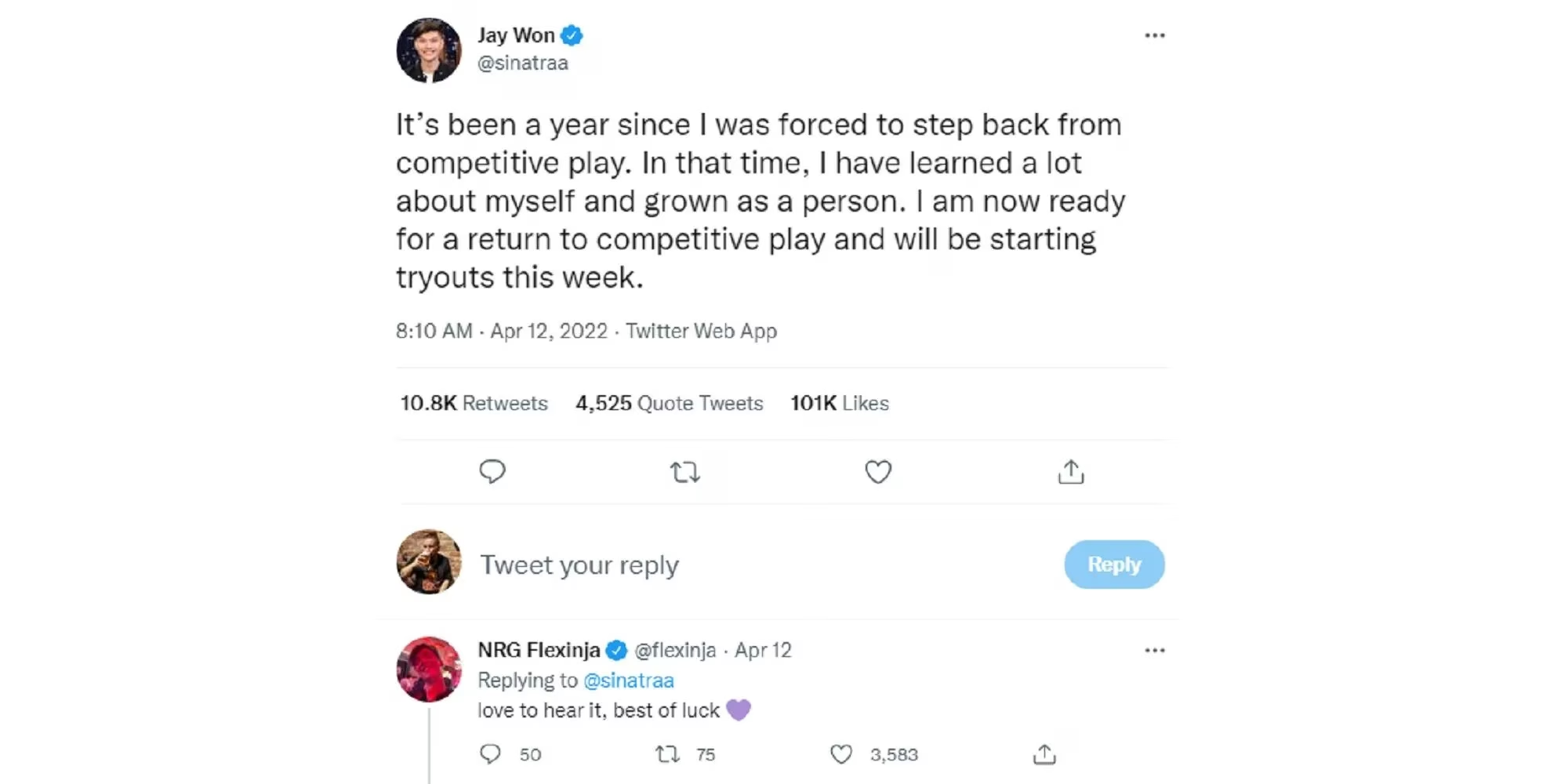
The core of the allegations, as detailed by Hernandez and documented at the time, described a pattern of coercive and non-consensual behavior. She provided audio recordings, text messages, and a personal narrative alleging multiple instances of assault. In her account, she described how Won ignored her explicit boundaries regarding contraception and consent. She further accused him of emotional manipulation and guilt-tripping when she declined intimacy. These are not minor grievances; they speak to a fundamental violation of trust and autonomy. In response, Won initially issued a denial on social media, claiming a differing recollection of their relationship and pledging full cooperation by providing 'full audio and video clips.' However, Riot Games' subsequent investigation found this commitment to be hollow.
The official suspension report from Riot was damning. It stated that Won 'misrepresented certain facts, made false statements, and did not cooperate with the investigation in a way expected of a professional VALORANT esports player.' Crucially, he never furnished the complete evidence he had publicly promised. This pattern of dishonesty during an official probe is, in my view, a professional and ethical failing as significant as the original allegations. It demonstrates a willingness to obstruct truth-seeking processes. Yet, after serving a six-month competitive suspension that concluded in late 2021, the pathway for his return was ostensibly cleared upon completion of mandated 'professional conduct training.'
The reaction to his potential comeback has been a study in contrasts, revealing the fractured nature of esports fandom.
-
The Welcoming Committee: A vocal segment of the community, including some fellow competitors, has met the news with applause and messages like 'welcome back king.' This perspective often prioritizes in-game mechanical skill and past competitive achievements over off-server allegations. For these individuals, the absence of a criminal conviction is interpreted as definitive exoneration, a dangerous oversimplification of how sexual assault cases frequently unfold.
-
The Critical Voices: Conversely, and unsurprisingly, it has largely fallen to women within the esports ecosystem to voice concern and contextualize the situation. Commentators like Indiana 'Froskurinn' Black have pointedly questioned the ethics of organizations considering signing a player with such a history. She highlighted the common reality that many assault cases do not result in criminal trials, due to the immense psychological and financial toll on victims and systemic hurdles, not a lack of merit.
The central dilemma for Riot Games and organizations like Sentinels is one of precedent. By facilitating a return with minimal lasting consequence—beyond a temporary suspension and unspecified training—what message is being sent? It risks validating a narrative where serious accusations can be weathered, truth can be obfuscated, and a triumphant return is possible once public attention shifts. This creates a perilous environment.
Consider the potential ramifications:
| Area of Impact | Potential Consequence |
|---|---|
| Community Safety | Signals to other potential victims that reporting may lead to little lasting accountability for high-profile players. 🤐 |
| Organizational Integrity | Places teams in a position where competitive gains are weighed against ethical sponsorship and fan perception. ⚖️ |
| Industry Reputation | Reinforces a perception of esports as a hostile space for women, deterring female players, casters, and professionals. 🚫 |
| Player Accountability | Establishes that lying during official investigations carries no significant long-term career penalty. 😶 |
Furthermore, Riot's own handling raises questions. The company suspended its probe because law enforcement was involved, but when the police investigation did not move forward, why was Riot's internal investigation not reopened? A company with its own documented history of workplace culture issues has a profound responsibility to model rigorous standards. Welcoming back a player who demonstrably lied during its own investigative process undermines the integrity of those very standards.
Looking at the scene in 2026, the debate transcends one player's career. It is about the soul of competitive gaming. True progress requires more than reactive suspensions and mandatory training modules. It demands proactive cultural shifts. If Valorant esports aspires to be a welcoming, professional, and forward-thinking sphere, it must grapple with hard questions: How do we define acceptable conduct? What does meaningful rehabilitation look like? How do we center the safety and dignity of all community members over the spectacle of star power?
The onus is not on the victims to prove their trauma beyond all doubt to a public jury. The onus is on the institutions—Riot Games, team organizations, and even the community itself—to demonstrate that certain lines, once crossed, have meaningful and lasting consequences. Failing to do so doesn't just allow one player back onto the server; it tacitly endorses a status quo where abuse is managed as a public relations problem rather than confronted as a fundamental breach of trust. The legacy of this episode will be determined not by win rates or tournament victories, but by whether the industry learned to value integrity as highly as it values a clutch play.