
In the ever-evolving landscape of digital entertainment, the boundaries between games and other media have become as fluid as shimmering hextech energy. As we stand in 2026, looking back at pivotal moments that shaped the industry, the RiotX Arcane event emerges as a landmark fusion, a cultural touchstone that redefined cross-platform storytelling. Initially launched in late 2021 to celebrate the premiere of Netflix's groundbreaking Arcane series, this ambitious endeavor by Riot Games was not merely a marketing campaign; it was the first major tremor in a seismic shift, a meticulously woven tapestry that connected disparate worlds under a single, enthralling narrative banner.
The Genesis of a Multiverse Event
The RiotX Arcane event was conceived as a "cross-game, cross-platform, cross-world experience," a promise that felt as audacious as building a city in the fissures of a canyon. It launched on November 6th, 2021, synchronizing with both the League of Legends World Championship finals and the global debut of the Arcane series. This strategic timing was no accident; it was a masterstroke designed to capture the collective imagination of millions. The event spanned across Riot's entire portfolio:
-
League of Legends & Wild Rift: Introduced themed game modes and character skins inspired by the series' iconic champions like Jinx and Vi.
-
Teamfight Tactics: Featured a special Arcane-themed set, allowing players to recruit characters from Piltover and Zaun.
-
Arcane (the series itself): Served as the narrative core and visual inspiration.
-
Valorant: This tactical shooter received perhaps the most intriguing and speculated-upon integration, teasing a bridge between its near-future aesthetic and Arcane's steampunk fantasy.
Valorant's Arcane Enigma
For VALORANT agents and players, the event was shrouded in tantalizing mystery. The official trailer offered a fleeting, ghostly glimpse—a new weapon skin that pulsed with an unfamiliar, almost organic energy, starkly different from the sleek, manufactured firearms of the VALORANT arsenal. It resembled a relic unearthed from Zaun's sumps, its design language speaking of gears, pipes, and volatile chemicals rather than polished polymers and digital scopes.
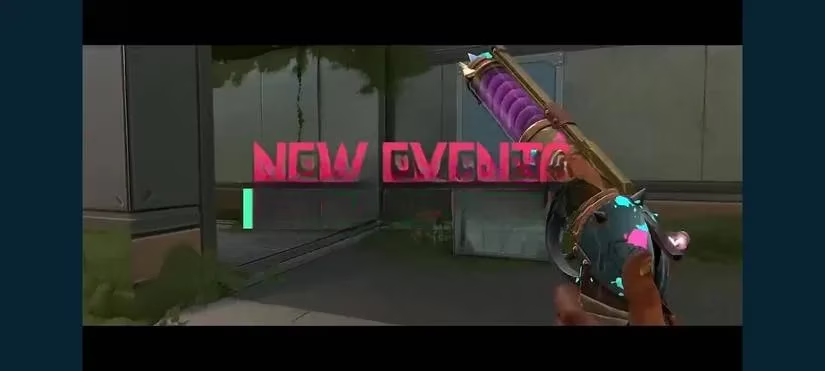
The community buzzed with theories. Was this skin part of a premium "Arcane Collector's set"? Or was it a key to a limited-time game mode, a portal where VALORANT's tactics would meet Arcane's chaos? Riot's announcement promised significant rewards:
| Promised Reward | Description |
|---|---|
| Free RiotX Arcane Pass | A battle pass offering tiered rewards. |
| Free In-Game Collectibles | Gun buddies, player cards, and other cosmetic items. |
| In-Game Arcane Collector's Set | A premium bundle of themed cosmetic items. |
| New Agent: Chamber | The charismatic weapons designer, whose release was strategically tied to the event's atmosphere of crafted armaments. |
The inclusion of Chamber was particularly resonant. His introduction felt like a deliberate narrative thread, a character whose ethos of bespoke weaponry was a perfect, albeit subtle, thematic bridge to the handcrafted, chaotic inventions of Arcane's world. The event also saw the release of the "Fishbones" gun buddy for Prime Gaming subscribers—a direct nod to Jinx's iconic rocket launcher, a small artifact from one universe appearing as a trinket in another, like a seashell found miles inland from any ocean.
Legacy and Lasting Impact
From the vantage point of 2026, the RiotX Arcane event is remembered not just for its content, but for proving a concept. It demonstrated that a compelling narrative could act as a golden thread, stitching together diverse gaming experiences into a cohesive meta-event. It showed that players were hungry for deeper connections between the worlds they invested in, treating the event less like a promotion and more like a festival celebrating a shared mythos.
The teased VALORANT skins, which later materialized in various forms, became coveted collector's items, their value appreciating like aged wine in a collector's cellar. They stood as artifacts from a time when Riot first dared to let its worlds bleed into one another. The event's structure became a blueprint, influencing how live-service games approach cross-media collaborations, moving beyond simple cosmetic drops to creating momentary, shared realities.
The RiotX Arcane event was, in essence, a carefully tuned hextech core—a catalyst that, when introduced to the disparate elements of Riot's game library, triggered a reaction far greater than the sum of its parts. It generated a resonance that echoed for years, proving that in the right hands, a story could be the most powerful weapon of all, capable of unifying entire player bases across the digital divide.
Ultimately, it was a bold declaration that the future of gaming lay not in isolated islands of content, but in archipelagos connected by the bridges of story, where a gun buddy from Zaun could hang proudly on a rifle in a VALORANT match, whispering tales of a sisterhood forged in the fires of two cities.