
Creating a game is a monumental task, but crafting one that players return to endlessly, year after year, is a rare and magical achievement. In the ever-evolving landscape of interactive entertainment, certain titles have proven themselves to be timeless, consistently drawing players back into their worlds long after the initial credits roll. These aren't just games; they are digital homes, hobbies, and communities. Their secret lies not just in expansive content, but in creating systems, stories, and sensations so compelling that the journey feels fresh with every new beginning. From vast, open worlds to tightly designed, infinitely variable runs, these games master the art of player engagement, ensuring that the question isn't 'if' you'll play again, but 'how' and 'when'.
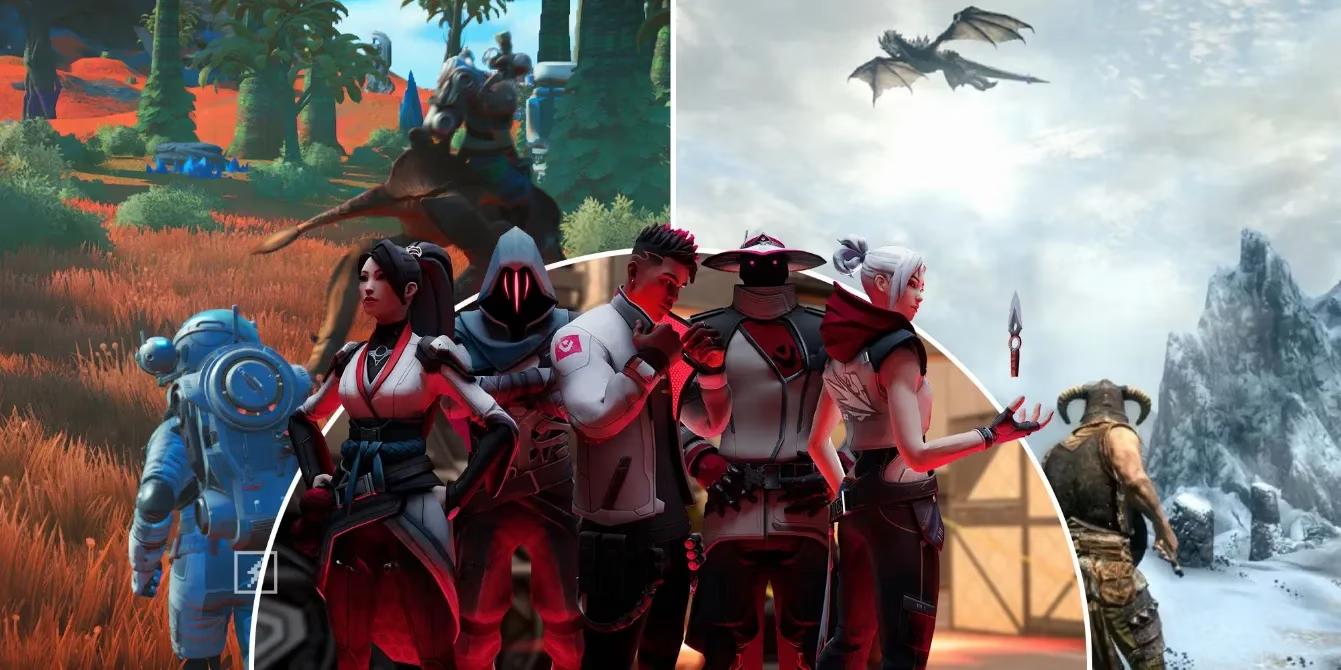
Among the pantheon of endlessly replayable games, The Elder Scrolls V: Skyrim stands as a titan. Its longevity is legendary, fueled by a potent combination of official content and a modding community that remains vibrant into 2026. Players aren't just exploring a province; they are shaping it. Want to be a stealthy archer who dabbles in dark magic? A noble paladin who smites dragons? The choice is entirely yours. The game's world feels alive with countless quests, hidden mysteries, and environmental storytelling that rewards curiosity. Every mountain path and ancient ruin holds a potential story, making each new character feel like a brand-new adventure.
Then there are games that build replayability directly into their narrative DNA. The Stanley Parable is a masterclass in this regard. It's less of a traditional game and more of a playful, philosophical exploration of choice and consequence—or the lack thereof. With a narrator who reacts, chides, and comments on your every move, the game actively encourages you to disobey, to explore, and to seek out its many conclusions. Unlocking all its secrets requires multiple playthroughs, each peeling back another layer of its clever, meta-commentary on gaming itself.
For those who thrive on competition and mastery, games like Valorant offer a different kind of endless appeal. 😎 This tactical hero shooter demands not just sharp reflexes, but deep strategic thinking. Learning the nuances of each agent's abilities, mastering map callouts, and coordinating with a team creates a high-skill ceiling that players spend thousands of hours striving to reach. The ranked ladder provides a constant, tangible goal, while regular updates with new agents and maps keep the meta-game fresh and exciting. It’s a game where the primary antagonist is often your own past performance, pushing you to improve.
On the opposite end of the spectrum lies the boundless cosmic sandbox of No Man's Sky. Its scale is almost incomprehensible, featuring a universe of procedurally generated planets. In 2026, thanks to years of substantial post-launch support, the game is a rich tapestry of exploration, base building, trading, and survival. You can become a nomadic explorer charting unknown stars, a wealthy industrialist harvesting resources, or a communal architect building sprawling bases. The lack of a rigid narrative is its greatest strength; your story is written by the planets you discover and the goals you set for yourself.
Few games have defined a cultural era like Fortnite. Its ability to reinvent itself has been key to its lasting power. What began as a player-versus-environment survival game transformed into a global battle royale phenomenon and has since become a dynamic platform for social play and live events. Epic Games' strategy of frequent, seismic updates—changing the map, introducing new mechanics, and collaborating with pop culture icons—ensures the experience never grows stale. It’s a living game that evolves with its audience, a digital playground that is as much about hanging out with friends as it is about claiming a Victory Royale.
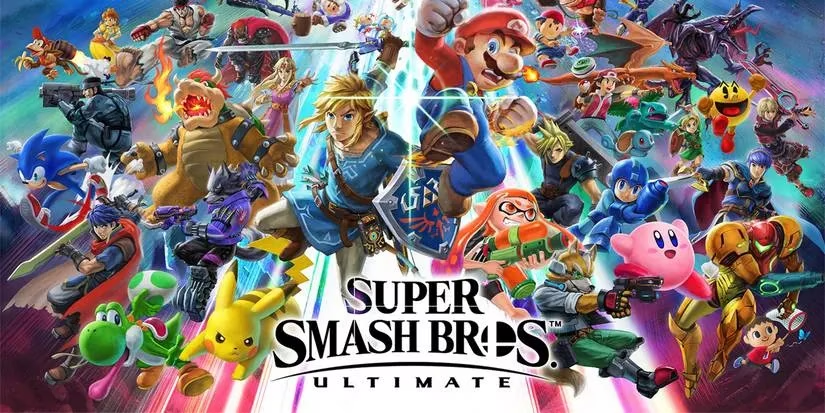
The ultimate party game and a serious competitive fighter, Super Smash Bros. Ultimate is a celebration of gaming history that offers something for everyone. 😄 With a colossal roster of characters, each with unique move sets, the possibilities for matches are nearly infinite. You can have a frantic, item-filled free-for-all with friends on the couch or dive into the depths of its technical combat online. The game’s 'World of Light' adventure mode offers a lengthy single-player experience, while the sheer volume of music tracks, spirits to collect, and stages to unlock provides goals for completionists. Its flexibility is its superpower.
When discussing infinite creativity, Minecraft is the undisputed king. This digital Lego set for the modern age provides the ultimate sandbox. Whether playing solo or on a bustling server, the game’s loop of gathering, crafting, and building is meditatively satisfying. In 2026, the game continues to expand with new biomes, mobs, and crafting options. Players can:
-
Construct elaborate castles and redstone-powered contraptions.
-
Venture into the deep, dangerous depths of the ancient cities.
-
Simply tend to a farm and watch the sun set over a blocky horizon.
Its simplicity is its genius, providing a framework for limitless imagination.
For nearly two decades, World of Warcraft has been a second home for millions. This MMORPG behemoth offers a fantasy life of unparalleled depth. The core loop of questing, dungeon-running, raiding, and player-versus-player combat is supported by a world rich with lore and history. Leveling a new character through revamped zones is a journey in itself, and each class offers a distinct playstyle. The social aspect—forming guilds, tackling epic raids with friends, or even just chatting in a capital city—creates bonds and memories that keep players subscribed year after year, exploring each new expansion's content.
FromSoftware's Elden Ring redefined the open-world genre by filling a massive, interconnected map with dense, rewarding content. The sense of discovery is relentless. You might stumble upon an entire hidden underground city, a legacy dungeon with a terrifying boss, or a quiet NPC with a tragic tale. This nonlinear design means no two playthroughs are the same. After defeating the final boss, players often dive into New Game+ to try a completely different build—swapping a mighty strength warrior for a delicate spellcaster—and discover secrets they missed the first time. The world is so meticulously packed that it demands to be re-experienced.
Finally, we have the quintessential roguelike: The Binding of Isaac: Rebirth. This game is replayability incarnate. Each run is a self-contained, randomly generated gauntlet of rooms, enemies, and items. With hundreds of items that combine in wild, unpredictable ways, no two runs are ever alike. One moment you're firing a barrage of tears, the next you've become a cyborg spewing laser beams, all because of the items you picked up. The drive to 'just one more run' to unlock a new character, defeat a new boss, or see a new item combination is incredibly powerful. It’s a game designed from the ground up to be played forever, and in 2026, with all its expansions, it remains a masterclass in procedural storytelling and compulsive gameplay.
| Game | Genre | Core Replay Driver |
|---|---|---|
| The Elder Scrolls V: Skyrim | Open-World RPG | Player freedom, modding, exploration |
| The Stanley Parable | Narrative Adventure | Meta-narrative, multiple endings |
| Valorant | Tactical FPS | Competitive mastery, strategic depth |
| No Man's Sky | Survival/Exploration | Procedural generation, sandbox freedom |
| Fortnite | Battle Royale/Platform | Constant evolution, social playground |
| Super Smash Bros. Ultimate | Fighting/Party | Huge roster, social & competitive play |
| Minecraft | Sandbox/Survival | Unlimited creativity, player-driven goals |
| World of Warcraft | MMORPG | Social world, endless progression |
| Elden Ring | Action RPG/Open-World | Dense exploration, build variety |
| The Binding of Isaac: Rebirth | Roguelike | Randomization, item synergies |
In conclusion, the magic of these games lies in their ability to make the player an active author of their own experience. Whether through boundless creation, competitive rigor, or endless procedural variation, they offer not just an escape, but a space to live, learn, and grow. They prove that in the world of gaming, the best stories are often the ones we create for ourselves, playthrough after playthrough. 🎮