
As I log in, the familiar hum of the client greets me, a portal to a world of precise angles and tactical whispers that has been my digital home for over half a decade. Valorant, Riot's tactical masterpiece, has woven itself into the fabric of competitive gaming, its polish and balance a testament to its enduring legacy. Yet, even as new agents with reality-bending abilities join the fray and maps evolve with intricate lore, a persistent, spectral issue haunts the ranked ladder's integrity—the specter of smurfing. This practice, where seasoned veterans don the guise of novices, casts a long, distorting shadow over what should be the purest test of skill. It’s a dissonant note in an otherwise symphonic competitive experience, a problem that has stubbornly persisted from the game's infancy into its mature years in 2026.
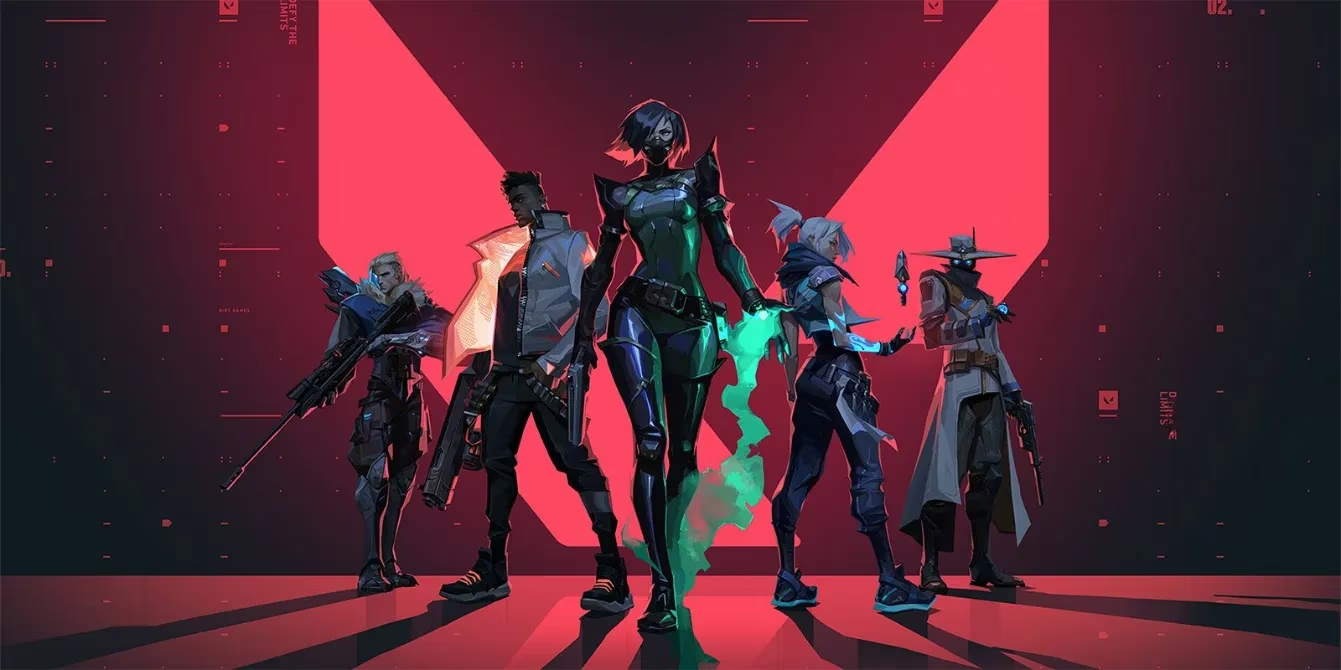
The heart of the issue lies in accessibility, a double-edged sword. Valorant’s free-to-play nature is its greatest strength, democratizing entry and fostering a massive, vibrant community. Yet, this very openness removes the primary barrier to creating a legion of alternate accounts. There is no financial gate, no purchase price to reconsider before crafting a new digital identity. Players are driven by a mosaic of motivations: some seek the fleeting thrill of dominance over less skilled opponents, a power fantasy that warps fair competition. Others are caught in a bind of camaraderie and skill disparity, where the rigid rank restrictions on grouping force friends apart. To bridge this chasm, they forge smurf accounts, artificially deflating their rank to play alongside companions, a well-intentioned act that nonetheless poisons the well for genuine newcomers.
The current gateway to Competitive mode feels, in my experience, like a screen door meant to hold back a storm. The requirement of ten unrated victories is a mere formality, a brief tutorial that does little to assess true skill or dedication. I recall my own early days, the frantic, joyful chaos of those initial matches, and how quickly they passed. Contrast this with other titans in the tactical sphere, where the path to ranked is a deliberate pilgrimage, requiring dozens of hours of immersion to even unlock the door. Valorant’s low barrier, while welcoming, inadvertently rolls out the red carpet for smurfs, allowing them to establish their altars in ranked temples with disheartening ease. The result? Lobbies become unpredictable gambles, where a match can be decided not by teamwork or strategy, but by the presence of a single player operating far outside their displayed rank, turning what should be a measured duel into a confusing rout.
The Ripple Effects on the Ladder
The consequences of unchecked smurfing create vicious cycles that stifle growth and breed frustration:
-
For New Players: The intended learning curve is shattered. Instead of gradual, skill-appropriate challenges, they face bewildering defeats that feel insurmountable, leading to early discouragement and attrition.
-
For the Competitive Integrity: The ranked badge loses its meaning. Climbing feels less about personal improvement and more about dodging smurfs or getting lucky.
-
For the Smurfs Themselves: Even they aren't immune. To maintain a low-rank account, some engage in deliberate subterfuge—throwing games or manipulating performance—which corrupts their own experience and that of everyone in those matches.
Pathways to a Clearer Future: Evolving the Systems
As Valorant continues to evolve, with its lore expanding and its esports scene reaching dazzling heights, the solutions to smurfing must also mature. The framework for improvement has been discussed for years, and in 2026, the technology and data available to Riot Games make sophisticated solutions more viable than ever.
1. A Tiered On-Ramp to Competitive:
The ten-win rule should be the first step, not the only one. A more robust system could involve:
| Stage | Requirement | Purpose |
|---|---|---|
| Access | 10 Unrated Wins | Basic game familiarity. |
| Placement | 50 Total Games Played (Unrated/Spike Rush) | Broader data collection on consistent performance. |
| Calibration | Performance-based MMR seeding from all modes | Uses hidden skill metrics to place new accounts more accurately, making it harder for smurfs to land in Iron/Bronze. |
2. Smarter, More Social Grouping Restrictions:
Instead of hard rank cut-offs that fracture friend groups, a dynamic system could be implemented. For instance, allowing wider rank disparities in a party but then matching that party against the average MMR of its members, weighted toward the higher-skilled players. This ensures the challenge remains fair for the opposition while allowing friends to play together. Additionally, a dedicated, ranked "Flex" queue with separate rankings for premade teams of varying sizes could siphon off the desire to smurf for camaraderie.
3. Behavioral & Hardware Trust Factors:
Riot's already formidable anti-cheat system, Vanguard, could be leveraged further. By analyzing patterns beyond cheating—like rapid skill inflation on a new account or frequent association with vastly lower-ranked players—algorithms could flag potential smurf accounts. These accounts could then be fast-tracked through placement matches or placed in quarantine queues with similar accounts, protecting the genuine new player pool.
I dream of a Valorant where every duel in Competitive mode feels earned, where a victory is sweet because it was hard-fought against a true peer, and a defeat is a lesson, not a confusing mystery. The grind up the radiant ladder should be a saga of personal growth, not an obstacle course of mismatched encounters. Riot has shown incredible dedication to this game, from introducing revolutionary PBE environments for community testing to crafting cinematic universe events that blur the line between game and narrative. Tackling smurfing with the same creative vigor is the next frontier. It’s not about building walls to keep people out, but about crafting smarter, more nuanced systems that guide everyone to where they truly belong. In 2026, with the game more popular and polished than ever, the community deserves a competitive ecosystem where skill is the only true currency, and every agent, from the newest recruit to the seasoned veteran, can find their honest fight.