
In the high-stakes arena of Valorant, every flick of the wrist and tactical decision is underpinned by a design philosophy as precise as a sniper's crosshair. For the developers at Riot Games, creating an Agent is less about sculpting a mere avatar and more about engineering a playable personality. As of 2026, this process remains a meticulous alchemy where competitive integrity, aspirational character, and narrative depth are fused into a single, battle-ready form. The goal isn't just to provide tools for victory, but to make pressing an ability button for the thousandth time feel as thrilling as the first—a challenge that goes far beyond polygons and hitboxes.
John Goscicki, a key architect behind Valorant's roster, frames it perfectly. Imagine maining Phoenix and casting his Curveball flash thousands of times over months of play. The design imperative is to make that single action feel powerful and satisfying every single time. The solution? A seamless marriage of personality, model, visual effects, and sound. "We could communicate the gameplay with just squares and circles," Goscicki notes, "but that wouldn't feel good. We want these to be powerful, aspirational characters that make you think, 'Damn, it'd be cool to be this person.'" In a game without traditional cutscenes, building this connection is like trying to paint a masterpiece using only the flashes of a strobe light—every glimpse must count.
🎯 Phase 1: The Gameplay Hook is the North Star
The birth of an Agent always starts with a vacuum. What playstyle is missing? What strategic niche is unexplored? This initial concept is a raw gameplay skeleton. For Yoru, the team wanted to introduce stealth as a "tangible thing you think about every few rounds." For KAY/O, the goal was a "simple, approachable character" with grounded FPS mechanics who could introduce the suppression effect to Valorant. This gameplay prototype is tested relentlessly. If it feels good to play, only then does it begin its transformation into a person.

As developers play the test build, they note the emergent fantasies. Yoru's kit encouraged outwitting and lurking, which naturally sculpted his personality into an edgy, "better-than-you" archetype. This isn't arbitrary; the team constantly balances the roster's gender spread and the mix of "edgy" versus "wholesome" characters, ensuring the cast feels like a dynamic, global ensemble rather than a monochrome squad.
🎨 Phase 2: From Archetype to Visual Identity
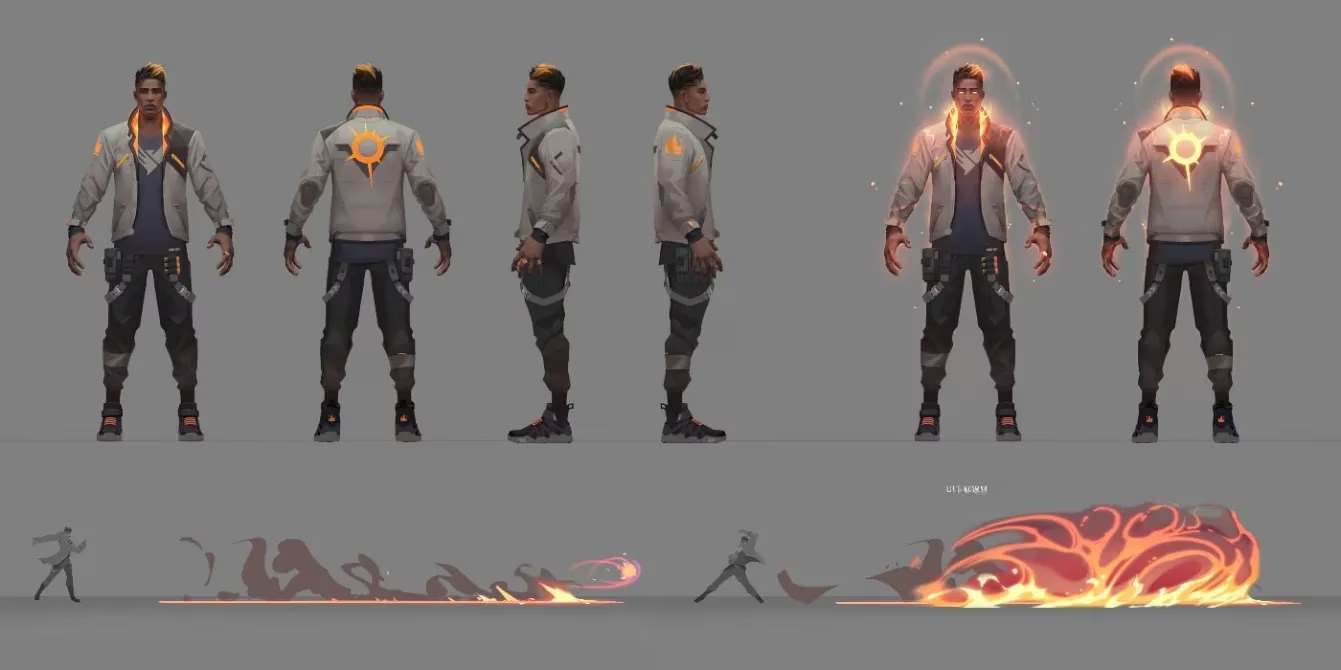
With thematic pillars in place, concept artists unleash a "shotgun spread" of designs. This phase is a playground of possibilities that often gets reeled in by the harsh realities of gameplay and worldbuilding. KAY/O, for instance, was once envisioned as a human in a mech suit or even "an animal robot" before landing on his now-iconic soldier-esque form. The core constraint? Every Agent must look "battle ready."
"All of our characters need to be able to pick up a weapon and shoot," Goscicki explains. "Their powers can always be stopped by a bullet. There's a reason you see a lot of pouches and belts." A silhouette must be instantly recognizable for competitive fairness, but a design can also fail for being too "high fashion." Striking the balance between interesting and believable is a tightrope walk over a canyon of artistic compromise.

🔊 Phase 3: Breathing Life into the Blueprint
Once the theme is locked, a multidisciplinary team—designer, writer, artist, engineer—convenes to translate personality into gameplay feedback. "Phoenix throws fire stuff," says Goscicki, "so it's a question of how these fire abilities get represented." Then, an army of 3D artists, animators, VFX wizards, and audio designers descends for pre-production. They build the Agent, flagging technical challenges like new engine requirements. The final blueprint is a meticulously crafted document that guides the entire team toward the Agent's launch-ready form.
🌍 The Soul of an Agent: Micro-Storytelling in a Macro World
Creative director David Nottingham describes the Valorant experience as "more like going to the local basketball court with friends." Forced, grand narratives feel like a mismatch. Instead, characterization is delivered in micro-doses: voice lines, select screen animations, cinematic trailers, and written bios. The game's near-future Earth setting is a crucial tool, allowing culture and identity to ground the Agents in reality.
Take Raze. She's not just "from Brazil"; she's specifically from Salvador, a city with a rich Afro-Brazilian heritage that directly shapes her vibrant, explosive identity. Representing this global cast authentically means consulting cultural experts to ensure the portrayal feels genuine and respectful. "The end goal," Nottingham says, "is to create characters that make players feel like this is a game that has space for them and can see them."
This depth extends to curated Spotify playlists for each Agent (except the robotic KAY/O) and cinematic shorts like The Color of the Town, which shows Raze vibing to a Brazilian remix while repairing her Boom Bot. These elements are like hidden lore collectibles, offering glimpses into who these Agents are when they're not in the heat of battle.
🪞 The Duality Dilemma: Lore as a Gameplay Echo
One of Valorant's most intriguing lore conceits is the existence of mirror-universe versions of every Agent. However, from a design standpoint, these alternates aren't radically different—yet. Nottingham explains the "fork in the road" between universes was recent, not decades ago, so there hasn't been enough time to "radically change who the character is." The alternate world isn't a post-apocalyptic wasteland; it's a parallel track with a few key divergences.
This narrative restraint is, once again, in service to gameplay. "I really like to think that the work we're doing always comes back to: How does this support the gameplay?" Nottingham emphasizes. Any future distinction between mirror Agents—in appearance or voice—would need to enhance the player's experience in a meaningful way. The lore, no matter how cool, must never become a noisy bystander shouting over the core tactical duel.
🔮 The Future: Narrative in the Nooks and Crannies
As Valorant evolves, the team is focused on distilling the "fundamental, human, emotional experience" of world-changing events into tiny, character-driven moments. Consistently updating voice lines gives the sense that the story—and the Agents—are moving forward in time. New maps and modes will continue to experiment with delivering these "small" narrative bits in a genre not known for its storytelling.
In the end, designing a Valorant Agent is like crafting a precision Swiss watch where every gear, from a belt pouch to a voice line quip, must synchronize with the central mechanism of tight, competitive gameplay. It's a process where a character's soul is not written in a script, but performed in the milliseconds between a flashbang's pop and a headshot's crack. For millions of players in 2026, that performance continues to be what makes pressing that ability button feel like an extension of themselves, time after time.