
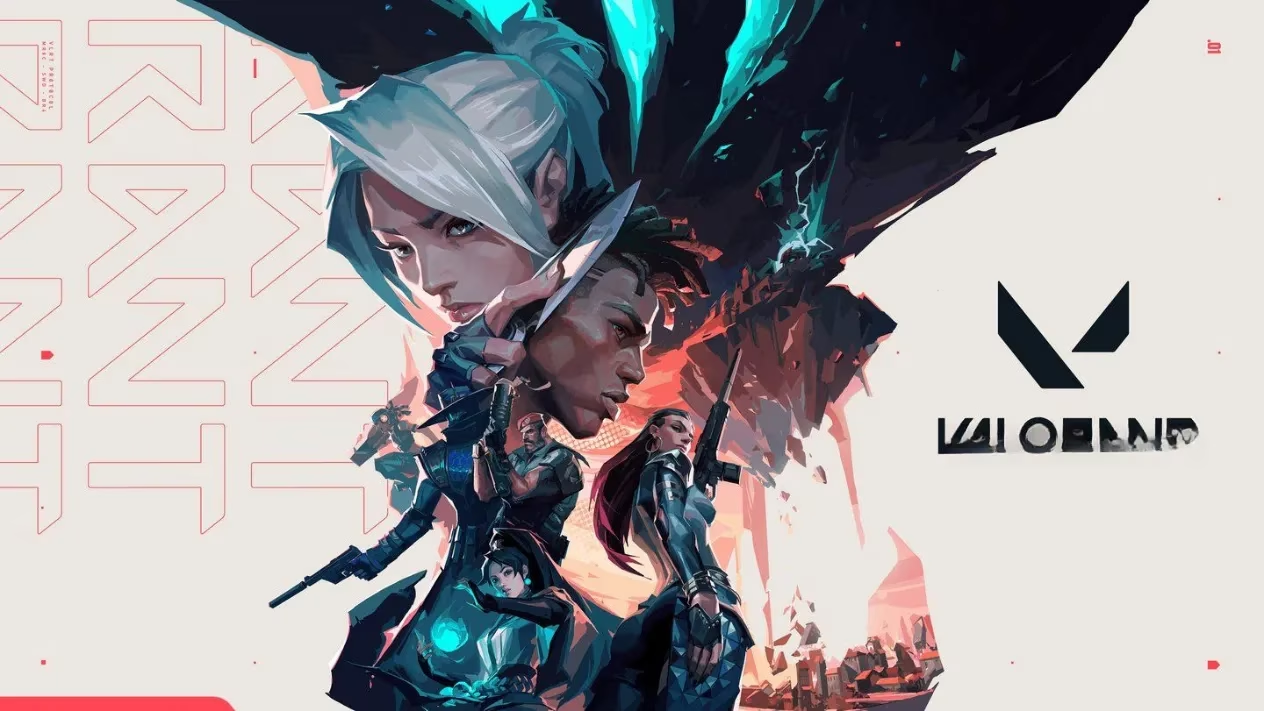
Valorant continues its relentless pace of evolution, with the upcoming Patch 2.06 poised to deliver some of the most impactful gameplay changes seen in recent memory. Following the conclusion of the Masters tournament, Riot Games is shifting focus back to the core game, addressing long-requested agent updates and introducing significant quality-of-life improvements that could reshape the tactical landscape. The community eagerly anticipates these adjustments, which aim to bring underutilized agents into the spotlight and refine the overall competitive experience.
Agent Updates: A New Era for Viper and Yoru
The centerpiece of Patch 2.06 is a comprehensive overhaul for two agents: Viper and Yoru. For Viper, the changes are designed to solidify her identity as a Controller who makes "big, committed decisions" that truly alter the map. Her toxin passive now inflicts a minimum of 50 decay instantly on enemies entering her abilities, with the decay increasing the longer they stay. This creates a more threatening zone of control. Her Poison Cloud and Toxic Screen now persist for an extra 2 seconds if she dies, and she can redeploy her cloud immediately after picking it up. New practice tools in custom games will also help players master her lineups more effectively.
Yoru receives a suite of buffs aimed at making his deceptive playstyle more consistent. His Blindside flash now activates faster and lasts longer. His Gatecrash ability no longer resets on kills but is replenished every 35 seconds, its lifetime is increased, and its stealth detection range is reduced. Most notably, his ultimate, Dimensional Drift, now costs only 6 points, and he can reactivate Gatecrash while in his spectral form. Additionally, Killjoy gets a small but welcome change, allowing her to pick up deployed Nanoswarm grenades during the buy phase.
Weapon Balancing: The Bucky Adjusts Its Bite
Riot is refocusing the Bucky shotgun, aiming to make its primary fire the go-to choice. The spread for both primary and alternate fire has been reduced for better reliability. However, the alt-fire's pellet count has been slashed from 15 to 5, making it a tool for chip damage at range rather than a primary kill method. The updated damage curve ensures more predictable performance: 20 damage per pellet from 0-8 meters, 12 from 8-12 meters, and 9 beyond 12 meters.
A Revolutionary Audio Experience: HRTF Arrives
One of the most significant additions is the Head Related Transfer Function (HRTF) audio toggle. This feature, accessible in the Audio settings, uses a simulated surround sound space to help players wearing headphones pinpoint crucial sounds like enemy footsteps, reloads, and Deathmatch respawns in 3D space. Riot notes that it may take some getting used to, recommending players practice in custom games or the Range to train their ears. For optimal results, players should disable any other external "3D Audio" processing while using HRTF.
Modes and Competitive Tweaks
The popular Escalation mode gets a refresh with ability updates and rare, surprise loadout variations. For example, Raze's Showstopper now comes with two Blast Pack charges, and the Snowball Launcher grants increased mobility. On the competitive front, players can now right-click on a leaderboard entry to view that player's career, including match history and Act Rank progress. Leaderboard players also have the option to label themselves as a 'Secret Agent' to maintain anonymity.
Other quality-of-life updates include an improvement to map ping legibility. As Valorant moves into 2026, Patch 2.06 represents a continued commitment to refining balance, enhancing strategic depth, and improving the core player experience based on community feedback and professional play observations. The changes, particularly to Viper and the audio system, have the potential to significantly shift the meta and raise the skill ceiling for dedicated players.