
Since its explosive arrival on the competitive scene, Riot Games' tactical shooter Valorant has firmly established itself as a premier title, offering a distinct blend of precise gunplay and strategic hero abilities. While the core competitive modes continue to captivate millions, a persistent request from a segment of the community has been for a more permanent, practice-oriented free-for-all (FFA) experience. The question on many players' minds has been: why hasn't an infinite or long-running FFA mode been implemented yet? The answer, as outlined by Riot's developers, lies at the intersection of technical complexity, player behavior, and resource allocation.
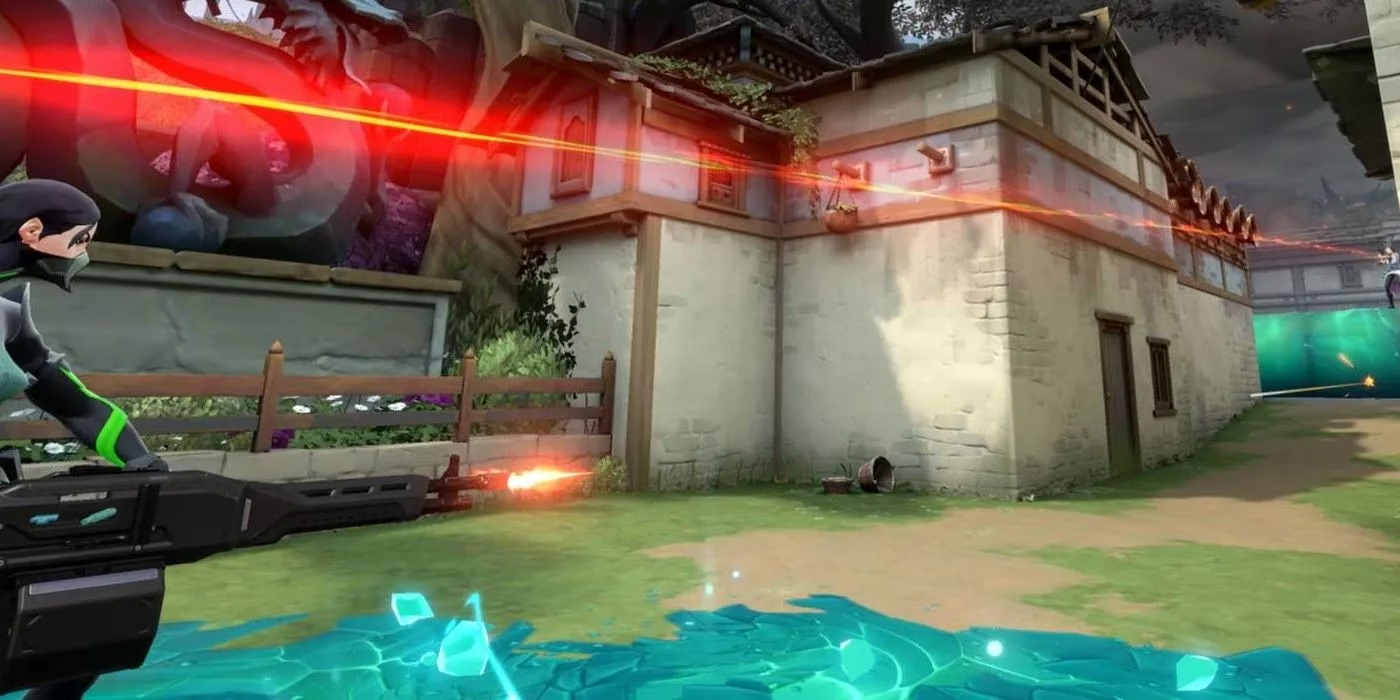
Principal Producer Jared Berbach provided clarity on the matter, emphasizing that the development of a "special version" of FFA is actively underway. However, its release hinges on overcoming significant technical hurdles. The current FFA Deathmatch mode operates on a closed-session model, meaning once a match starts, no new players can join. For an infinite or persistently running mode to function, this foundational system requires a complete overhaul. The game's underlying code needs to be re-engineered to allow for dynamic matchmaking that can seamlessly slot players into ongoing sessions. This is no small feat, as it involves reworking core networking and matchmaking systems, which explains why Riot has been unable to commit to a specific release timeline.
But is the demand for such a mode substantial enough to warrant this intensive development effort? Berbach's insights reveal a nuanced picture. Data shows that while the existing FFA Deathmatch population is smaller compared to the flagship Competitive or Unrated modes, those who play it are highly engaged. This mode currently serves players who enjoy a short, focused warm-up session with a clear objective and a winner. Riot's goal with an infinite FFA is to expand this audience and cater to a different need altogether. Imagine a dedicated, low-pressure sandbox where players can:
-
Practice mechanics indefinitely without the pressure of a timer or scoreboard.
-
Experiment freely with new agents, like the recently introduced controller, without impacting a team's performance.
-
Warm up on-demand by jumping into an active session at any moment.
This vision suggests the new mode would act less as a competitive fixture and more as a dedicated training ground, potentially improving the overall skill floor and match quality in Valorant's primary modes.
However, this development focus is not without its critics. A portion of the community questions the prioritization of a niche practice mode over other pressing issues. Given that the FFA-playing demographic is a minority, some argue that Riot's resources would be better spent on:
-
Developing new maps, agents, and game-changing content.
-
Addressing persistent bugs and balancing the core gameplay experience.
-
Enhancing anti-cheat measures and server stability.
From this perspective, creating an infinite FFA could be seen as an indulgence for a vocal minority, potentially diverting attention from features that would benefit the broader player base. Yet, Riot's stance, as communicated by Berbach, is that this investment will pay long-term dividends by creating a healthier ecosystem for player improvement.
As of 2026, the landscape of hero shooters continues to evolve, with titles constantly adding new ways to engage players outside of ranked ladders. Valorant's potential infinite FFA mode represents Riot's acknowledgment of this trend. The development challenge is clear: they must build a robust, technically sound platform that supports drop-in, drop-out gameplay—a feature common in other genres but more complex in a precise, server-authoritative game like Valorant. The success of this endeavor will ultimately be measured by its adoption. Will it become the essential warm-up hub for aspiring pros and casual players alike, or will it remain a seldom-visited corner of the client?
In conclusion, the journey toward an infinite FFA mode in Valorant is a fascinating case study in game development priorities. It balances the clear desires of a dedicated player segment against the substantial technical and resource costs required to realize them. Riot's careful, albeit slow, approach indicates a desire to implement the feature correctly rather than quickly. For now, players eager for endless duels must continue to wait, with the assurance that the project is in motion, poised to eventually deliver a new kind of playground within Valorant's meticulously crafted world.