
Imagine stepping into a Valorant match, confident in your map knowledge, only to find everything you know turned completely upside down. That's the brain-melting reality presented by a series of viral clips that have taken the community by storm. These aren't new arenas; they're the classic battlegrounds of Valorant—Split, Icebox, Haven, and more—but seen through a looking glass, flipped and inverted in a way that makes even seasoned pros do a double-take. This dizzying perspective shift offers a fresh, if slightly nauseating, way to look at the tactical spaces players have committed to memory over countless hours.
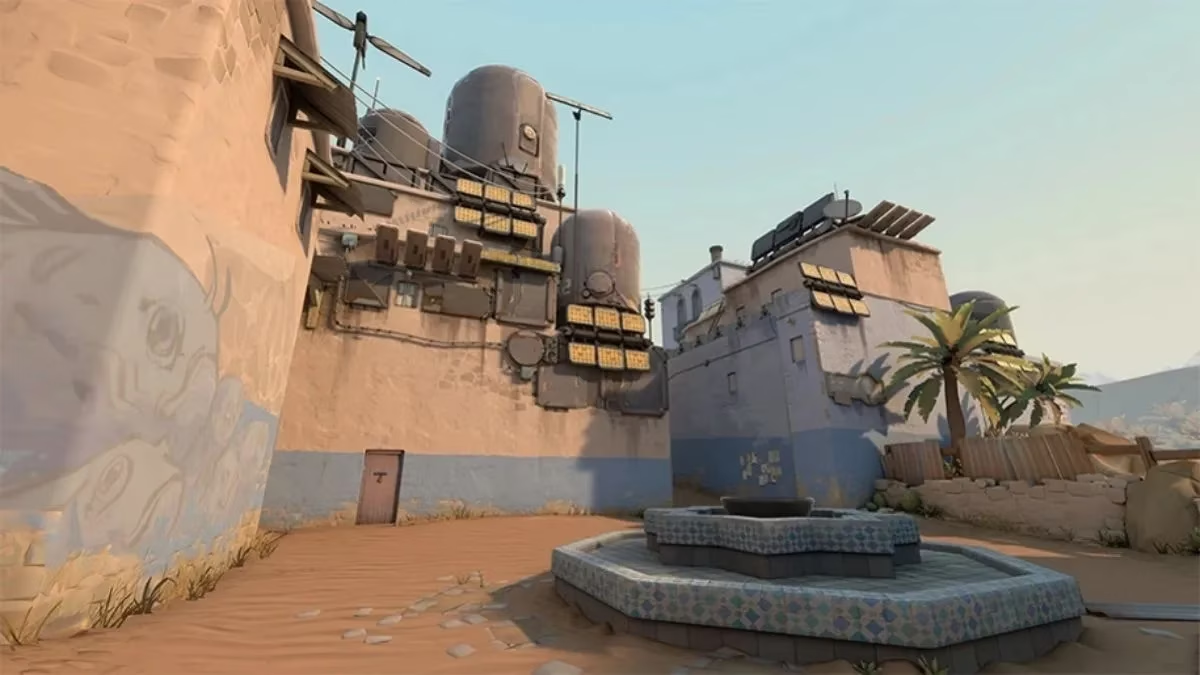
The Viral Source: A Creator's Crazy Vision
The mastermind behind this cartographic chaos is a Valorant content creator known as Cloudkronos on TikTok. With a flair for the visually disorienting, Cloudkronos cooked up and released a series of short videos showcasing exactly what each map would look like if it were inverted. The effect is immediate and profound; familiar lanes, chokepoints, and bomb sites are all there, but their spatial relationships are flipped, creating a surreal and challenging new landscape. It's like your brain's GPS just crashed and rebooted in a funhouse mirror.
The clips really blew up when professional Valorant player NRG Wedid stumbled upon the "Inverted Split" video and shared it with his followers on social media. His warning was simple and accurate: "this will definitely hurt your brain." And you know what? He wasn't wrong. The community's reaction was a mix of awe, confusion, and a little bit of motion sickness. It was a certified 'wait, what?' moment for everyone who saw it.
A Tour of the Twisted Terrains
Let's take a closer look at what these inverted versions actually do to these iconic arenas. The original Valorant map pool includes tactical masterpieces like Bind, Haven, Split, Breeze, Icebox, Ascent, and Fracture. Each has its own personality, its own flow. The inversion process doesn't add or remove geometry; it simply mirrors the entire environment. The result is a map that is technically the same, but feels entirely foreign.
For example:
-
Inverted Split: The tight mid-corridors and the ziplines become a topsy-turvy puzzle. The usual angles for holding or pushing sites feel completely off.
-
Inverted Icebox: The vast, vertical spaces of Icebox become even more disorienting when flipped. Navigating between Tube and the sites becomes a literal head-scratcher.
-
Inverted Haven: With its three bomb sites, Haven's complexity gets multiplied. Trying to coordinate a rotate in this version would be, well, a real trip.
Cloudkronos didn't stop there. Videos for Bind, Ascent, Breeze, and even the newer, already complex map Fracture were also unleashed upon the world. It's a full set of mind games, freely available for anyone brave enough to look.
Why It Captivates: More Than Just a Gimmick
So, why did these clips resonate so deeply? Valorant is a game built on precision, strategy, and deep map knowledge. Players spend hundreds, even thousands of hours learning every nook, cranny, and pixel-perfect angle. The inverted maps throw all that hard-earned muscle memory out the window. They force the brain to engage with the space in a completely new way, highlighting just how much of our gameplay is based on subconscious spatial awareness.
It's a testament to the game's design that these maps remain recognizable even when inverted. The core layout is strong enough to withstand this visual trickery. For content creators and theory-crafters, it opens up wild 'what-if' scenarios. Could practicing on an inverted map improve your overall spatial reasoning? Probably not, but it sure makes for a hilarious and challenging custom game mode with friends.
The Community's Playful Spin
The Valorant community, never one to miss a beat, ran with the idea. Memes flooded social feeds, with players joking about needing dramamine to watch the clips or claiming they'd finally found their true rank if they could perform in the inverted world. It sparked creative discussions about game perception and even led to some players trying to re-create the feeling in custom games by simply turning their monitors upside down—a low-tech but effective method to achieve a similar, if less polished, effect.
While these inverted maps aren't an official game mode (and honestly, Riot Games would be brave to even consider it), they serve as a brilliant piece of community-driven content. They remind us that even in a highly competitive esports title like Valorant, there's always room for fun, creativity, and a good old-fashioned brain teaser. As the game continues to grow, with the Valorant Champions Tour captivating millions globally and former pros from other titles joining the fray, it's these moments of shared, quirky experience that strengthen the community bond.
In the end, Cloudkronos's inverted maps are more than just a visual glitch or a filter. They're a love letter to the game's design, a challenge to its most dedicated players, and a reminder that sometimes, you just have to look at things from a different angle—even if that angle is completely upside down and gives you a slight headache. Talk about seeing the game in a whole new light!