
Since its explosive debut in 2020, Valorant has firmly cemented its place at the forefront of the tactical shooter genre. Six years on, its evolution continues, driven by Riot Games' commitment to refining the competitive ecosystem and enhancing player experience. The 2.05 patch, while now a part of the game's history, represented a significant step in that ongoing journey, introducing foundational quality-of-life features and systemic improvements that have shaped the title's development philosophy for years to come. The update's core focus was on granting players finer control, fostering fairer competitive play, and addressing disruptive behaviors with more sophisticated tools.
The most celebrated addition for many strategic players was the introduction of unique keybinds for specific agent abilities. This allowed for unprecedented customization, separating vertical movement controls from the standard jump and crouch keys. Sova mains could now assign dedicated buttons for ascending and descending with their Owl Drone, enabling smoother scouting and dart placements. Similarly, Astra received the same treatment for navigating her Astral Form, giving controllers more precise and intuitive star placement high above the battlefield. This change was a direct response to community feedback, acknowledging that complex agents deserved more granular input options to unlock their full potential.
On the competitive front, the 2.05 patch rolled out several features aimed at transparency and accountability. Players gained new control over their public profile with a toggle to show or hide their Act Rank in the Career tab. The Match History received a long-requested filter, allowing competitors to sort games by mode—finally making it easy to analyze Competitive performance in isolation. Perhaps most impactful was the introduction of a rank rating penalty for dodging Competitive queue games, a move designed to discourage last-second lobby exits and improve match integrity. Furthermore, Riot fine-tuned the Radiant rank's rating gains and losses to align more closely with the behavior in Immortal, smoothing out the progression at the very pinnacle of the ranked ladder.
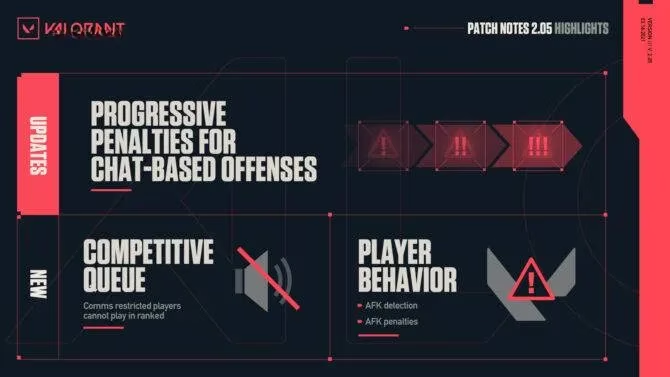
A major pillar of the update was a comprehensive overhaul of the game's social and penalty systems. Riot deployed improved AFK detection algorithms to more accurately identify players who were inactive, followed by updated, harsher penalties for AFK offenses. This was coupled with revised sanctions for chat-based misconduct. The patch notes reiterated a zero-tolerance policy for severe offenses, which would trigger automatic game bans. These systemic changes were implemented to directly tackle the numbers advantage gained by teams with AFK players and to cultivate a less toxic in-game environment—a continual battle in any competitive online title.
No update is complete without a slew of bug fixes, and 2.05 was no exception. The patch addressed a wide array of glitches that ranged from visual hiccups to game-breaking issues. Key fixes included:
-
Astra starting Spike Rush with all 5 star charges (as intended).
-
Preventing Killjoy from exploiting geometry to place her Lockdown ultimate in unintended, off-ground locations.
-
Fixing Cypher's Spycam dart from occasionally penetrating walls and hitting players on the other side.
-
Resolving a rare but critical bug that could completely freeze a player's movement and inputs when entering or exiting a "scout" ability like Astra's Astral Form or Sova's Drone.
-
Correcting the defuse range circle indicator, which had previously failed to display properly after a spike plant.
Additional fixes targeted observational clarity, corrected ability interactions (like Skye's seekers on Brimstone's map), and resolved minor visual bugs like a detached Stinger stock. Each fix, while potentially small on its own, contributed to a more polished and predictable gameplay experience.
Looking back from 2026, the Valorant 2.05 patch stands as a testament to Riot's player-driven development approach. The introduction of agent-specific keybinds set a precedent for deep customization that later agents would benefit from. The strengthened AFK and competitive systems established a framework that has been iterated upon in countless subsequent updates to maintain match quality. By listening to its community and addressing both major pain points and subtle bugs, Riot used this update to reinforce the core values of fairness and precision that keep Valorant thriving years after its release.